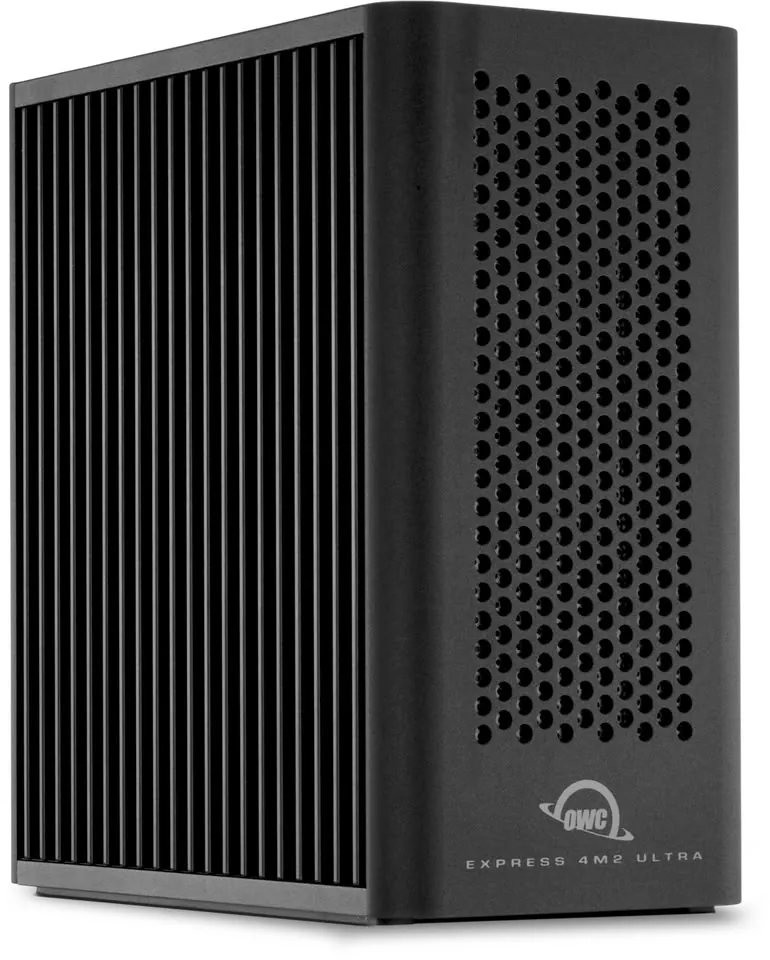
OWC has announced the Express 4M2 Ultra, a four-slot NVMe RAID enclosure on Thunderbolt 5. Storage enclosures are where interface bandwidth stops being a specification-sheet number and becomes a transfer time somebody is waiting on — which makes them a good place to look at what Thunderbolt 5 asks of the cable.
What Thunderbolt 5 actually provides
| Thunderbolt 4 | Thunderbolt 5 | |
|---|---|---|
| Symmetric bandwidth | 40Gbps | 80Gbps each way |
| Asymmetric mode | — | 120Gbps one way / 40Gbps the other |
| Power delivery | Up to 100W | Up to 240W (USB PD 3.1 EPR) |
| Connector | USB-C | USB-C |
| Underlying standard | USB4 | USB4 Version 2 |
The asymmetric mode is aimed at displays, where almost all the traffic runs one direction. For storage the number that matters is the symmetric 80Gbps — double Thunderbolt 4, and enough that a RAID of modern NVMe drives can actually saturate it.
The drives can outrun the interface
80Gbps is nominally 10 GB/s, and protocol overhead puts real-world storage throughput below that. A single current-generation NVMe drive already reads at several GB/s, so a four-slot enclosure in a striped array is not bandwidth-starved by its drives — it is bounded by the interface and, in practice, by the cable holding that interface up.
That inverts the usual assumption. With Thunderbolt 4 at 40Gbps the enclosure was the bottleneck often enough that cable choice hardly showed. At 80Gbps the array has headroom to spare, which means any shortfall you measure is coming from somewhere else — and the cable is the cheapest place to look first.
Why the cable becomes part of the specification
Thunderbolt 5 uses the same USB-C connector as a USB 2.0 charging cable. That is a convenience for users and a trap for buyers, because the connector says nothing about what the cable can carry. Three things separate a Thunderbolt 5 cable from something that merely fits:
- An eMarker declaring the rate. The chip announces the cable's data rate and current rating over the CC pin before anything negotiates. A cable that cannot declare 80Gbps will not run at 80Gbps.
- Construction that holds the loss budget. At 80Gbps the tolerance for insertion loss, inter-pair skew and impedance discontinuity is very tight, and it has to hold along the whole length rather than at the ends.
- An honest length. Passive cables at these rates run out near one metre. Longer means active — with electronics in the connector — or optical.
The failure mode is not a dead link. It is a link that negotiates down, silently, and delivers a fraction of the throughput the enclosure is capable of. Nothing reports an error; the copy just takes longer.
What to specify
- The declared data rate and current rating as the eMarker reports them — not the figure on the box.
- Passive or active, and the length, stated together. A 2 m passive cable at 80Gbps is not a product.
- The power rating separately. 240W and 80Gbps are independent fields; a cable can have one without the other.
- A test report naming the laboratory and the sample tested.
Where our own cables sit
- USB Type-C 40Gbps / 240W Cable, 2m — PLT588 — eMarked for 5 A and 40Gbps
- All USB-C cables
Tell us the rate, the length and the power you need and we will tell you plainly whether it is a passive, active or optical build — including when the honest answer is that the length you want does not exist in copper.
Ask us for the specification sheet
Tonetron is the export brand of Dongguan Taitron Electronic Limited (东莞台昶电子有限公司), a cable and connector manufacturer in Dongguan, Guangdong, China, established in 1984. We build HDMI, DisplayPort, USB-C and custom cables on our own lines and ship factory-direct to more than 40 countries.
- Email: sales@tonetron.com
- Phone: +86-0769-83356158
- Contact form: tonetron.com/contact
Tell us the target specification, quantity and destination market and we will send the matching datasheet and a quote.