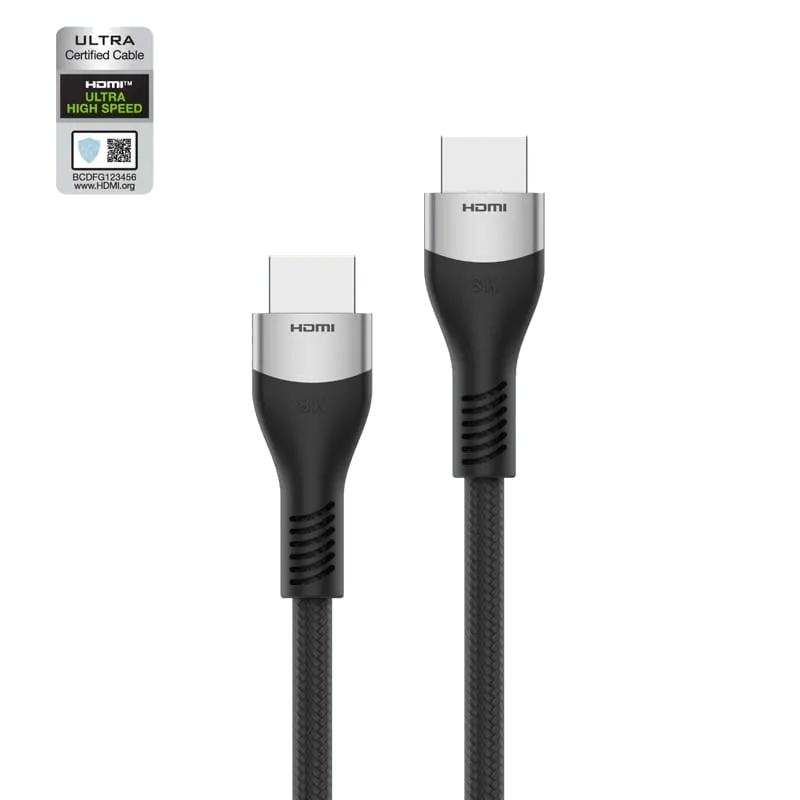
HDMI versions describe the capabilities of the specification and the cable and devices, not just a connector shape. The three that matter for current sourcing decisions are HDMI 2.0, HDMI 2.1 and the newer HDMI 2.2 specification announced by the HDMI Forum. This article compares their bandwidth, resolution and refresh limits and the features that separate them, using real cable examples from our factory.
Specs at a glance: HDMI 2.0 vs 2.1 vs 2.2
| Specification | Max bandwidth | Headline resolution / refresh | Cable class |
|---|---|---|---|
| HDMI 2.0 (2.0/2.0a/2.0b) | 18 Gbps | 4K @ 60Hz | Premium High Speed (up to 18 Gbps) |
| HDMI 2.1 / 2.1a | 48 Gbps | 8K @ 60Hz, 4K @ 120Hz | Ultra High Speed (48 Gbps, certified) |
| HDMI 2.2 (announced specification) | Up to 96 Gbps | Up to 16K (specification-stage) | Ultra96 (new cable class) |
Bandwidth is the ceiling that determines which resolution, refresh rate and color depth combinations a link can carry. Higher resolution, higher refresh and richer color (for example 10-bit or 12-bit, 4:4:4 chroma) all consume more bandwidth.
HDMI 2.0: reliable 4K at 60Hz
HDMI 2.0 carries 18 Gbps, which is enough for 4K (3840×2160) at 60Hz. It remains the practical baseline for a large share of TVs, monitors, signage and everyday AV connections. A representative HDMI 2.0-class cable from our range uses OFC oxygen-free copper conductors, 24K gold-plated HDMI connectors and a zinc-alloy shell, rated for 18 Gbps and 4K@60Hz.
HDMI 2.1: 8K, high-refresh 4K and Ultra High Speed cables
HDMI 2.1 raises the ceiling to 48 Gbps, enabling 8K@60Hz and 4K@120Hz, along with features aimed at high-performance video and gaming. To carry the full 48 Gbps reliably, cables must meet the Ultra High Speed HDMI certification. Our HDMI 2.1 Ultra High Speed certified cable is built for this: 48 Gbps bandwidth, 8K@60Hz 4:4:4 / 4K@120Hz, a nylon-braided jacket, an aluminium shell, and heavy shielding (160 aluminium shielding wires, 95% coverage). We hold HDMI 2.1 product certification, supported by an in-house HDMI 2.1 ATC (Authorized Test Center) test qualification.
Key HDMI 2.1 features include:
- Fixed Rate Link (FRL) signaling to reach 48 Gbps
- Variable Refresh Rate (VRR)
- Auto Low Latency Mode (ALLM)
- Enhanced Audio Return Channel (eARC)
- Display Stream Compression (DSC) support for the highest formats
HDMI 2.2: the announced next step
The HDMI Forum announced the HDMI 2.2 specification, defining bandwidth up to 96 Gbps and a new Ultra96 cable class, targeting very high resolutions and refresh rates for future displays, professional and AR/VR applications. Because HDMI 2.2 is at the specification stage, the figures above are best treated as draft/announced capabilities: broad device availability and finalized cable certification are still emerging. Sourcing decisions today should center on HDMI 2.1 Ultra High Speed for high-end needs and HDMI 2.0 for mainstream 4K, while planning for HDMI 2.2 as it matures.
How an HDMI version is actually verified
A version number on a box is a claim. What turns it into evidence is a test report against a specific Compliance Test Specification (CTS) revision, performed at an HDMI Forum Authorized Test Center (ATC).
This matters when sourcing because the CTS revision moves independently of the HDMI version. "HDMI 2.1 certified" without a CTS revision and a date does not tell you which test suite the sample actually passed.
| Certificate # | Tested model | CTS revision | Test centre | Issued |
|---|---|---|---|---|
| 5QSIMQP4DLG | PF331S-0300 — 3 m | 2.1b | Granite River Labs Dongguan | 2023-03-10 |
| 2JCHSF3SL1X | PF331A-0300 — 3 m | 2.1a | Granite River Labs Dongguan | 2021-06-12 |
| MG3CQ3Z4BAG | TT-1.8-2.1 — 1.8 m | 2.1a | Granite River Labs Dongguan | 2021-03-04 |
- A certificate covers the model and length that were tested, not a family. The 3 m PF331A above is certified; a 5 m cable of the same series is a different electrical problem and needs its own test.
- An ATC confirmation is not a quality guarantee for every unit shipped — the certificate says so in its own notes. It evidences that a submitted sample passed, on that date, to that CTS revision.
Full certificate details, including our USB-IF USB4 certification (TID 6801), are on our certifications page.
What we test in-house, before a sample ever reaches an ATC
External certification is a snapshot of one sample. Production consistency is decided by what gets checked every day. Our own test room runs:
- EDXRF spectrometer — element analysis for RoHS screening on incoming copper, plating and moulding compound.
- Constant temperature and humidity chamber — accelerated environmental ageing of finished assemblies.
- Automatic plug-and-pull tester — connector insertion and withdrawal cycling to a specified life count.
- Cable bending tester — repeated flex at the strain relief, where consumer HDMI cables most often fail first.
- Tensile testing machine — pull-off force at the overmould-to-cable joint.
Each station carries its own posted work instruction. If you are auditing a supplier, ask for those instructions and the raw test log for a specific production lot — a factory that runs the tests will have both.
Our certified HDMI cables are listed under HDMI cables; the USB4 cable carrying TID 6801 is PF587A-0080.
Which HDMI cable should you specify?
- 4K @ 60Hz displays, signage, general AV: an 18 Gbps HDMI 2.0-class cable is sufficient and cost-effective.
- 8K, 4K @ 120Hz, gaming, high color depth: specify an Ultra High Speed (48 Gbps) HDMI 2.1 certified cable.
- Future-proofing beyond 48 Gbps: monitor HDMI 2.2 / Ultra96 availability; validate real certified product before committing volume.
Cable length, shielding and connector quality all affect whether a link sustains its rated bandwidth over distance, which is why certified construction matters most at 8K and above.
Request an OEM/ODM quote
Tonetron is the export brand of Dongguan Taitron Electronic Limited (东莞台昶电子有限公司), a cable and connectivity manufacturer in Dongguan, Guangdong, China. We supply HDMI, USB-C, DisplayPort and custom cables worldwide, with OEM/ODM and private-label programs.
- Email: sales@tonetron.com
- Phone: +86-0769-83356158
- Contact form: tonetron.com/contact
Tell us your target specification, quantity and destination market and our team will respond with a tailored quote. MOQ, sample, tooling and lead-time figures are project-specific — please contact us for a quote.