If you’ve sourced cables from China, you’ve probably talked to four different companies that all claimed to be “the factory.” One offered a price that seemed too good to be true. Another had a polished website but couldn’t answer basic engineering questions. A third sent a sample that looked identical to a major brand’s product — but wouldn’t tell you who made it.
This article maps the four types of cable sellers you’ll encounter, what each is good for, and the specific risks. It complements our earlier guide on How to Tell a Real Cable Factory From a Trading Company, which focuses on factory-vs-trader signals. Here we look at the bigger picture: which type fits your order size, quality requirements, and timeline.
1. Source Factory (Owns Production Lines)
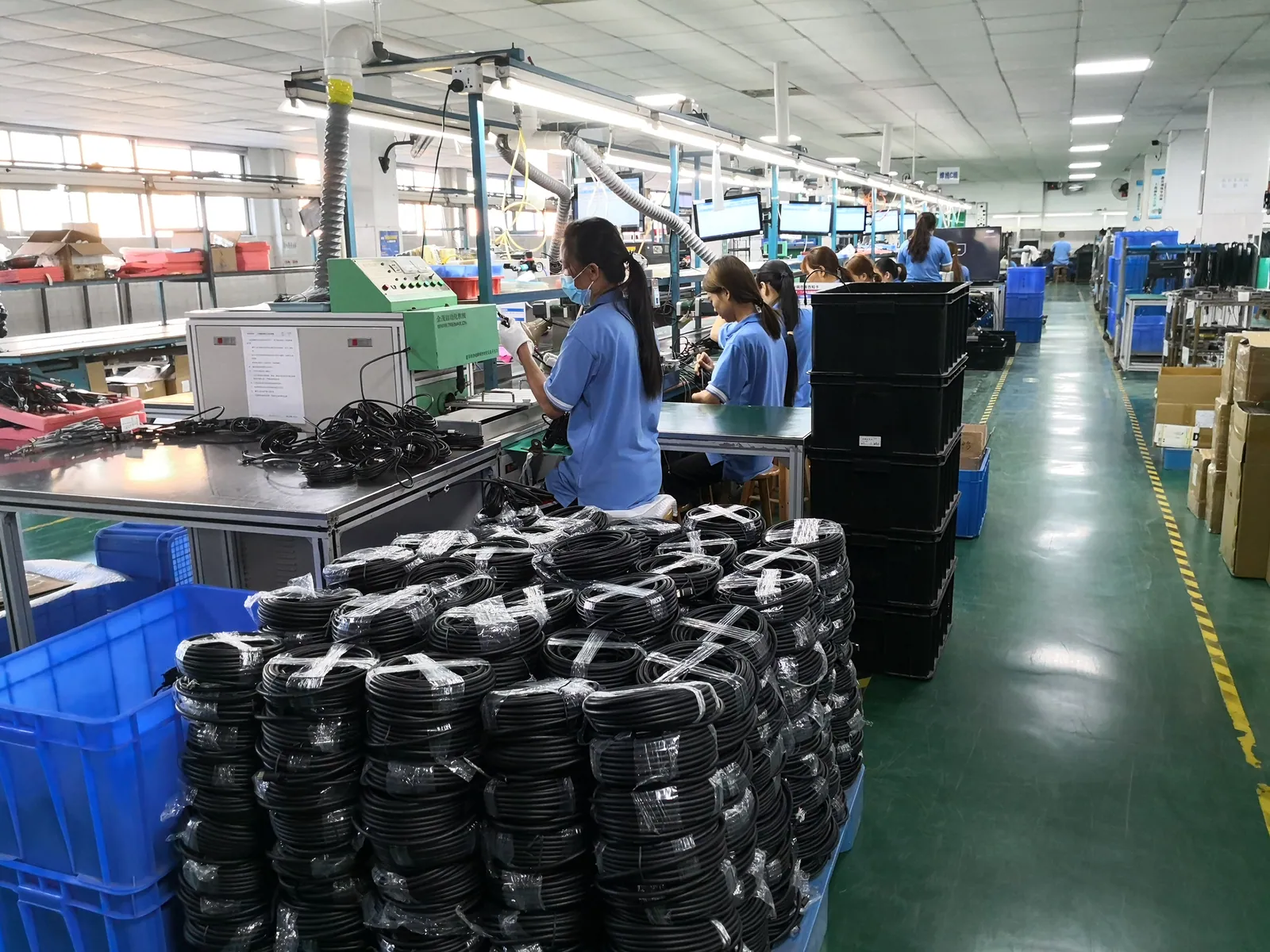
A source factory owns its extrusion, assembly, and testing equipment. It can modify cable structures, change molds, and run full electrical and protocol tests in-house. Tonetron is this type: founded 1984, relocated to a self-built 50,000 m² industrial park in Dongguan in 1993, with 9 production lines, 300+ employees, and a monthly capacity of 1M+ units.
Strength: Full control over quality and lead time. Engineering changes are direct — no middleman. You can request a custom connector housing, a different jacket material, or a specific braid pattern, and the factory can prototype it.
Risk: MOQ is constrained by production line efficiency. A source factory will rarely go below its standard MOQ unless the order is a repeat or part of a larger commitment. Lead times can be longer during peak seasons because the factory’s own lines are booked.
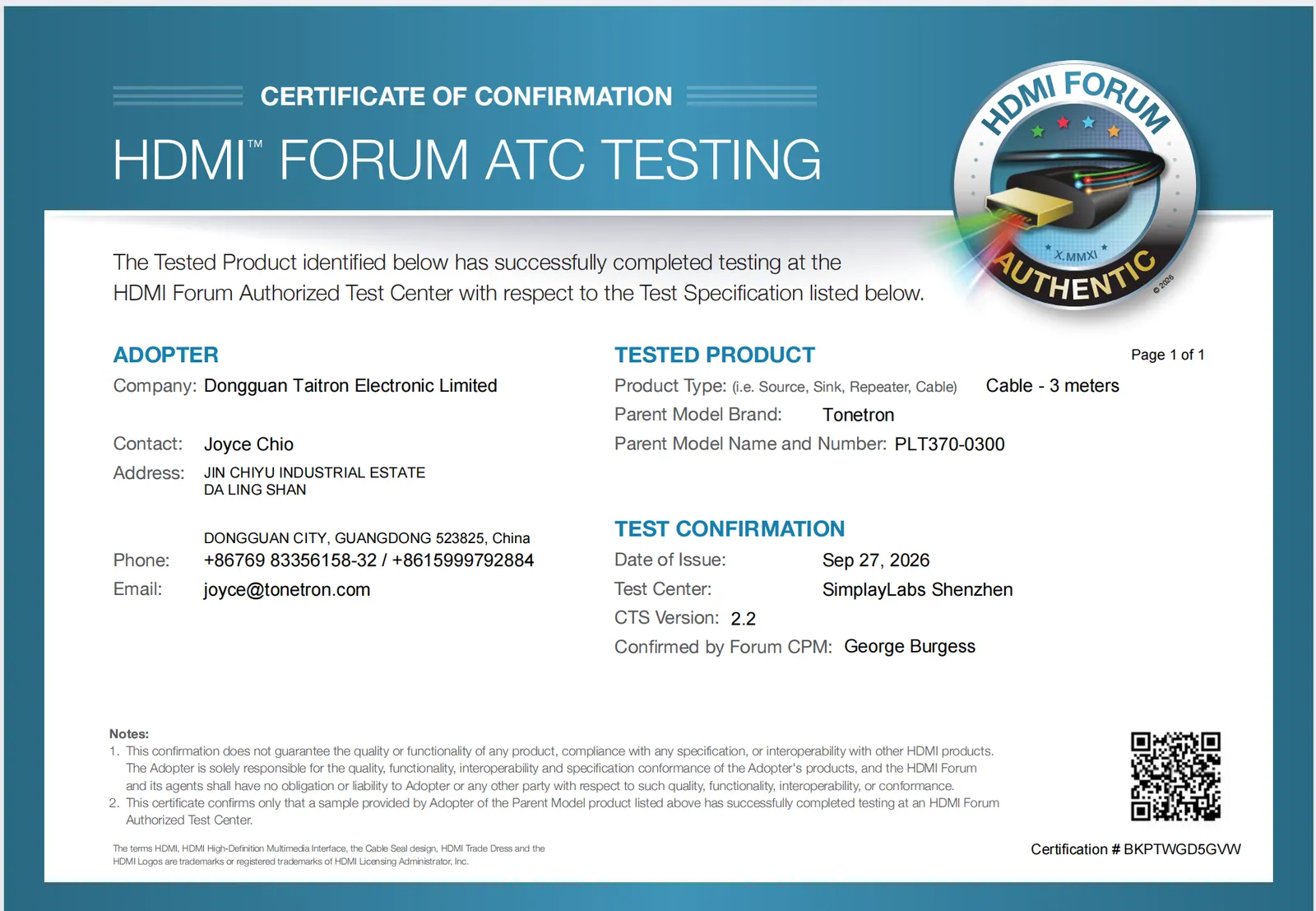
Best for: Buyers who need custom designs, consistent quality across large volumes, or long-term partnerships. Certification follows the legal entity that holds it, so always ask whose name is on the HDMI™ Adopter entry or the USB-IF TID — a factory, a brand or a trader can each be the holder.
Verify by: Ask for a live video walkthrough of the production floor. Check the business license — the factory address should match the registered office. Request a third-party factory audit report (BSCI, SGS, or similar).
2. Trading Company (Aggregates Multiple Factories)
A trading company doesn’t own production lines. It sources from several factories, bundles products, and handles logistics. Its strength is flexibility: it can combine cables, adapters, and accessories from different suppliers into one shipment, and often accepts smaller MOQs than a source factory.
Strength: One-stop shopping for a mixed product basket. Lower minimum order quantities. Faster response on standard items because they pull from existing stock.
Risk: Engineering issues require a round trip through the trader to the factory. Quality responsibility is split — if a cable fails, the trader may blame the factory, and the factory may blame the trader’s specification. You can’t audit the actual production line directly.
Best for: Small-volume buyers who need a variety of standard cables and don’t require custom engineering. Also useful for testing a new market with minimal commitment.
Verify by: Ask for the factory name and address on the quotation. If they refuse, that’s a red flag. Request a sample that matches the production batch — not a pre-made sample from a different source.
3. Platform Operator (Alibaba Store / Independent Website)
A platform operator runs an online store — Alibaba, Global Sources, or a standalone e-commerce site — but may not own any production. Some are trading companies; others are small factories that outsource most of their production. The key signal is whether they can provide a third-party factory audit report.
Strength: Easy to find, easy to compare prices. Often responsive and willing to ship small quantities. Good for spot buys or urgent needs.
Risk: The person you talk to may have no engineering background. Product specifications on the listing may be copied from a source factory’s datasheet. If the cable fails, the platform operator may not have the equipment to diagnose the issue.
Best for: One-off purchases, replacement orders, or very small test runs where certification and traceability are not critical.
Verify by: Ask for a video call showing the production line — not a pre-recorded video. Check if the business license address matches the factory address. Request a sample and measure the electrical parameters yourself.
4. Brand Contract Manufacturer (OEM/ODM for Brands)
This type runs high-quality production lines but works primarily for branded customers. They typically have the equipment and certifications — HDMI™ Adopter, USB-IF, ISO 9001 — but their sales model is built around large, predictable orders with NDA-protected designs.
Strength: Excellent production capability, rigorous quality control, and deep engineering expertise. They can handle complex certifications and custom tooling.
Risk: Low interest in small orders. They may quote a high price for a 1,000-unit trial because it disrupts their production schedule. Confidentiality agreements may prevent them from showing you their full product range or naming their brand clients.
Best for: Established brands that need a reliable manufacturing partner for high-volume, certified products. Also suitable for buyers who plan to scale quickly and want a factory that can grow with them.
Verify by: Ask for a list of certifications under the factory’s own legal name — not a distributor’s. Check the HDMI™ Adopter directory or USB-IF TID database. Request a factory audit report that includes the production line count and employee numbers.
Quick Comparison Table
| Type | Strength | Risk | Best for | Verify by |
|---|---|---|---|---|
| Source Factory | Full control over quality & engineering | MOQ constrained by line efficiency | Custom designs, large volumes, long-term partnership | Live video walkthrough, business license address, third-party audit report |
| Trading Company | Flexible MOQ, multi-category bundling | Engineering issues require round trip, quality responsibility split | Small-volume mixed orders, market testing | Factory name & address on quotation, sample matching production batch |
| Platform Operator | Easy to find, fast response, small quantities | No engineering background, specs may be copied | One-off purchases, urgent needs, very small test runs | Video call showing production line, business license address match, sample measurement |
| Brand Contract Manufacturer | High-quality lines, deep engineering, certifications | Low interest in small orders, NDA restrictions | Established brands, high-volume certified products | Certifications under factory’s own name, HDMI™/USB-IF database check, audit report |
Questions to Ask — and What Each Type Typically Answers
| Question | Source Factory | Trading Company | Platform Operator | Brand Contract Manufacturer |
|---|---|---|---|---|
| Can you modify the cable structure or mold? | Yes, with engineering team | No, must ask factory | Usually no | Yes, but under NDA |
| What is your MOQ for a custom design? | Set by the production run (ours is 1,000 pcs per custom model) | Can pool orders across buyers, so sometimes lower — but the factory behind them still has a floor | Often low, because they may be reselling stock | Usually high; small programs are not their business |
| Can I visit your production line? | Yes, on-site or live video | No, but can arrange factory visit | May not have own line | Yes, but with appointment |
| Do you hold HDMI™ Adopter status? | Often, under own name — check the directory | Sometimes (a trader can be an Adopter); otherwise relies on the factory’s | Rarely | Often, under own name |
| How long does a sample modification take? | Ask for their typical turnaround | Ask for their typical turnaround | Ask for their typical turnaround | Ask for their typical turnaround |
| Can you provide a third-party audit report? | Yes | Yes, but from factory | May not have one | Yes |
FAQ
How do I know if a supplier is a source factory or a trading company?
Start with the business license. The registered address should be the same as the factory address. Then ask for a live video walkthrough of the production floor — not a pre-recorded video. A source factory can show you extrusion lines, assembly stations, and testing equipment in real time. A trading company cannot.
What if I need a small quantity of a certified cable?
For certified cables (HDMI™ 2.1, USB4), what matters is that the certificate names the product you are buying and a legal entity you can trace — usually that means a source factory or a brand contract manufacturer, although a trader can hold an HDMI™ Adopter licence too. Expect a higher MOQ, but you get traceability and a certificate that matches the product. If the MOQ is too high, consider a trading company that stocks certified cables from a known factory, but verify the certificate matches the batch.
Can a platform operator be a real factory?
Yes, some small factories run their own Alibaba store. The test is the same: ask for a live video walkthrough, check the business license address, and request a third-party audit report. If they can show you the production line and the address matches, they are a source factory operating a platform store. If not, treat them as a platform operator.
Related reading: How to tell a real cable factory from a trading company: a buyer’s checklist · What determines MOQ for custom cables.
Request an OEM/ODM quote
Tonetron is the export brand of Dongguan Taitron Electronic Limited (东莞台昶电子有限公司), a cable and connectivity manufacturer in Dongguan, Guangdong, China. We supply HDMI™, USB-C, DisplayPort and custom cables worldwide, with OEM/ODM and private-label programs.
- Email: sales@tonetron.com
- Phone: +86-0769-83356158
- Contact form: tonetron.com/contact
Tell us your target specification, quantity and destination market and our team will respond with a tailored quote. MOQ, sample, tooling and lead-time figures are project-specific — please contact us for a quote.