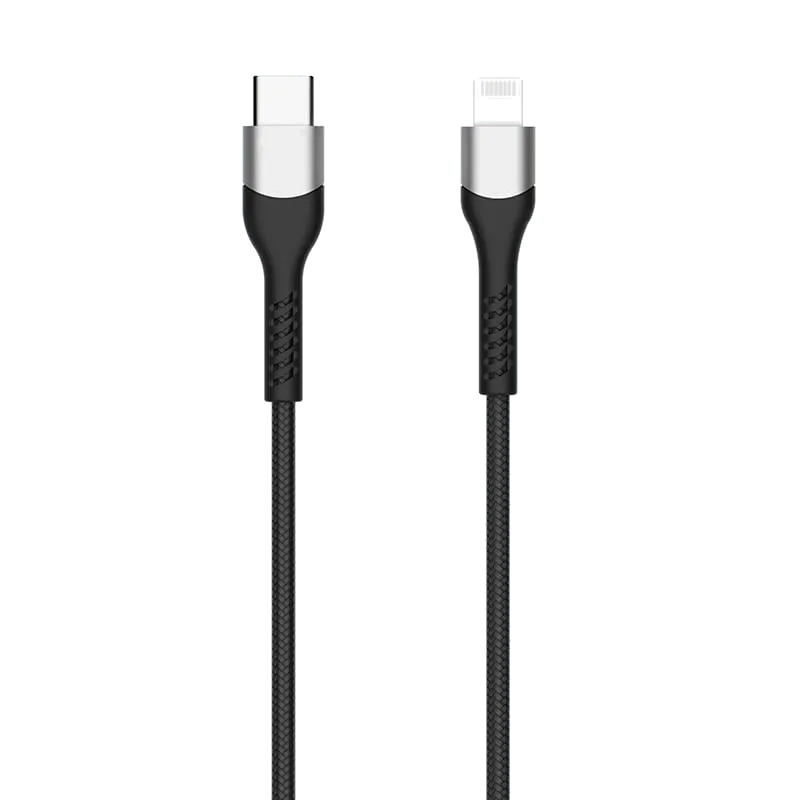
MFi is Apple’s licensing program for accessories that use its licensed technologies. Once the necessary program requirements have been completed, the licensee may include the appropriate MFi badge on the accessory’s packaging and user guide.
Certification Details
Certified products on the market clearly display the Apple MFi logo. Apple allows authorized manufacturers to print the authorized label on product packaging. The unified logo designed by Apple has very strict and demanding usage rules. Successfully obtaining MFi authorization has become a symbol of the technology and quality strength of Apple accessory manufacturers and design enterprises.
Security of Authentication
Normal charging, playback or data synchronization, and the absence of a warning, do not by themselves establish MFi certification. For purchasing, check the specific model using Apple’s MFi Licensed Accessories search. If no matching result appears, ask the supplier to clarify the model’s certification and listing status.
The question to ask an MFi supplier
MFi is a licensing programme, not a test certificate, and that difference decides who is actually accountable for your order.
Product-level MFi and factory-level MFi are not the same thing
An accessory’s certification and a manufacturer’s MFi authorization must be checked separately. Apple requires manufacturers making their own MFi accessories, and contract manufacturers and ODMs developing, manufacturing or performing sub-assembly for MFi accessories, to join the program. Manufacturers intending to manufacture MFi accessories or procure MFi components must also complete an MFi System Review. Distributors and resellers sourcing finished MFi accessories from an authorized MFi manufacturer do not need to join solely for that activity.
We state our own position plainly: our MFi cables are built with genuine Apple connectors and are MFi-certified at the product level, and our factory is not itself an MFi licensee. MFi certification can be arranged for a project that requires it. We would rather say this than let the words "MFi cables" imply a licence we do not hold — the same reason we say elsewhere that our HDMI™ certificates were issued to us as an Adopter, with the testing performed by an independent Authorized Test Center.
Ask for the connector part code, not just "MFi"
Apple's connector modules carry part codes, and they are not interchangeable:
- C89 — USB-A to Lightning. Our PF347 and PLT347 use this part.
- C94 — USB-C to Lightning, the part that supports USB-C Power Delivery fast charge. Our PF444 uses this part and is rated 30 W PD.
A supplier who answers "yes, MFi" without naming the connector code has not answered the question. C89 and C94 behave differently on charging, and substituting one for the other changes what the cable can do.
Three checks before you place an MFi order
- Whose MFi account is the order enrolled under? Ask for the name. If the answer is vague, the supply of genuine connectors is the thing at risk.
- Which connector part — C89 or C94? And does it match the charging specification you were quoted?
- Is the PPID available for the specific model? Apple assigns a product plan ID per enrolled model; it is the closest thing MFi has to a number you can check.
Our MFi cables are listed under MFi Lightning cables.
Code of Conduct for Certification
Apple is committed to ensuring that its supply chain factories provide safe working conditions, treat workers with respect, and are environmentally responsible in their manufacturing processes. Apple's suppliers must comply with the laws, regulations and decrees of the countries in which they operate in all their business activities. Based on internationally accepted standards, Apple's Supplier Code of Conduct provides more specific provisions to enhance corporate social and environmental responsibility and requires suppliers to implement this standard by establishing and maintaining their own management policies and procedures. The Code borrows from and includes parts of the Electronic Industry Code of Conduct (EICC) and references recognized standards such as those of the International Labour Organization (ILO), the Universal Declaration of Human Rights, Social Accountability International (SAI) and the Ethical Trading Initiative (ETI).