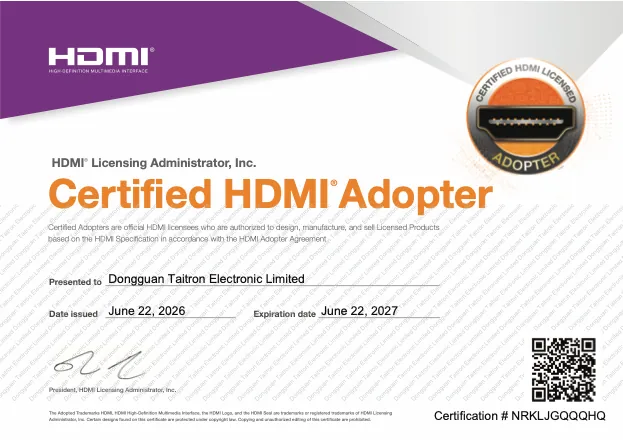
Displays keep moving to higher resolutions and higher refresh rates, and the cables that feed them should come with results from an authorized test center. Tonetron has been an HDMI™ Adopter since June 2005 and designs and builds its cables in its own factory in Dongguan (50,000 m² of floor space, 9 production lines, 300+ employees), with an ISO 9001-certified quality system.
On 27 September 2026, SimplayLabs Shenzhen — an HDMI Forum Authorized Test Center (ATC) — issued a Certificate of Confirmation for our 3 m HDMI™ cable, model PLT370-0300: a sample of this model successfully completed ATC testing under Compliance Test Specification (CTS) 2.2, Certification # BKPTWGD5GVW.
What does CTS 2.2 refer to?
CTS is the compliance test specification that HDMI Forum Authorized Test Centers test against. Version 2.2 corresponds to version 2.2 of the HDMI™ Specification, released by the HDMI Forum in June 2025.
The HDMI™ 2.2 Specification raises maximum bandwidth to 96Gbps using a next-generation form of Fixed Rate Link (FRL) technology. It covers resolutions and refresh rates up to 12K@120 and 16K@60, as well as uncompressed full-chroma formats such as 8K@60 and 4K@240 at 4:4:4 with 10- or 12-bit colour. The specification is backward compatible with earlier versions.
What does HDMI™ 2.2 mean in everyday use?
Everything below describes what the HDMI™ 2.2 Specification itself supports. What a complete setup actually delivers depends on the specifications of the source, the display and the cable.
High-refresh-rate gaming. The specification supports high-refresh-rate formats such as 4K@240 and carries forward the gaming features Variable Refresh Rate (VRR), Auto Low Latency Mode (ALLM) and Quick Frame Transport (QFT). For players, that means high-frame-rate video can reach the display intact, with less tearing and lag when you whip the camera around.
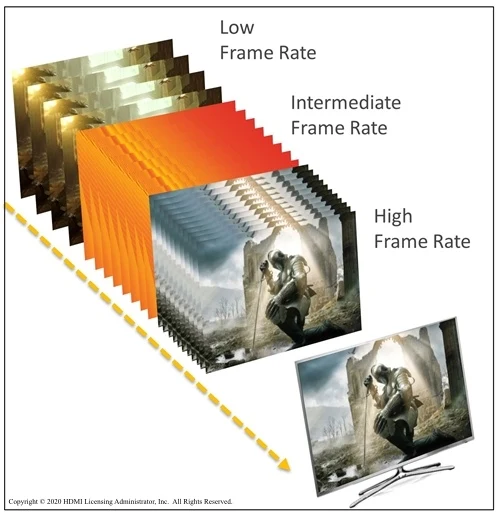
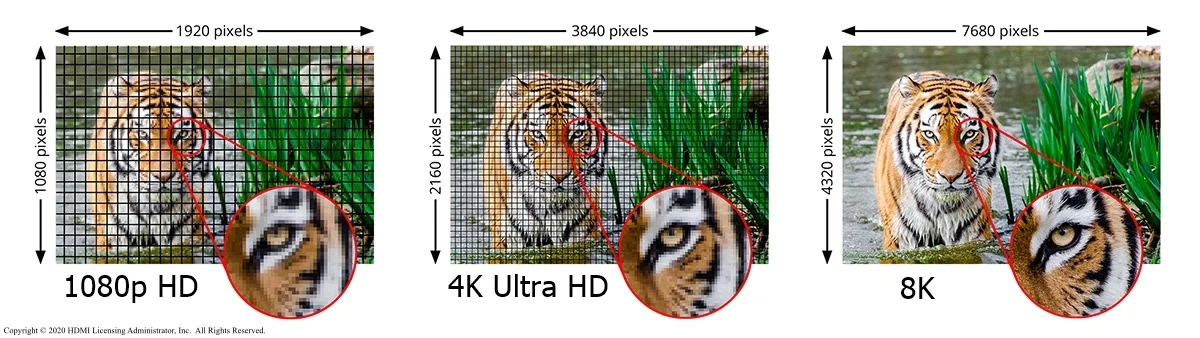
8K home cinema. The specification supports uncompressed 8K@60 at full chroma (4:4:4), with 10- or 12-bit colour depth. On a large TV or projector, that means shadow detail and smooth colour gradients do not have to be traded away to compression to save bandwidth.
Keeping sound and picture in sync through an AV receiver or soundbar. The specification adds the Latency Indication Protocol (LIP). When the signal runs from a player through an AV receiver to a TV or soundbar, every extra device adds its own processing time. LIP is designed for exactly these multi-device chains: it improves audio-video sync, so voices are less likely to drift away from lip movements.
Professional displays and showrooms. The specification supports up to 16K@60 and 12K@120. For showroom video walls, design reviews and data visualisation, where pixel density matters, that means a higher ceiling on the picture formats a single link can carry.
Which cable category goes with HDMI™ 2.2, and how can you recognise it?
The cable category that goes with the HDMI™ 2.2 Specification is the Ultra96 HDMI™ Cable, with up to 96Gbps of bandwidth; the Ultra High Speed HDMI™ Cable introduced with HDMI™ 2.1 is for systems up to 48Gbps. Under HDMI LA’s rules, both belong to a mandatory certification program: every cable model must pass certification testing at an HDMI Forum Authorized Test Center, and certified cables carry a certification label on each package. Scanning the label with a standard QR code app shows the brand, model and length, which guards against counterfeits and makes each package traceable.
Also under HDMI LA’s trademark rules, cable products are not named with HDMI™ version numbers, which is why this article calls our product a “3 m HDMI™ cable, model PLT370-0300”.
What does the confirmation mean, and what does it not mean?
- The certificate states its own limits: it confirms only that a sample of PLT370-0300 completed testing at an HDMI Forum ATC. It does not guarantee the quality, functionality or specification compliance of any product; the adopter remains responsible for its products.
- It covers the tested 3 m model only and does not extend to other lengths or models.
- SimplayLabs Shenzhen ran the test; Tonetron is not an ATC. We are an HDMI™ Adopter, licensed since June 2005.
- The ATC test confirmation described here is a test result issued for a sample; this article does not claim that PLT370-0300 carries an Ultra96 certification label.
How can you verify it yourself?
Scan the QR code in the lower-right corner of the certificate: it opens a verification page on hdmi.org showing the adopter name (Dongguan Taitron Electronic Limited) and the certificate number (BKPTWGD5GVW). The full certificate image is on our HDMI™ Adopter page, together with our other ATC certificates.
Can you make it shorter than 3 m?
Tonetron was founded in 1984. The tested sample is 3 m; lengths of 3 m and shorter can be built to order, with jacket colour, connector housing, packaging and branding made to your specification. Please confirm with our sales team before you order which tests apply to a specific model or length.
Product page: PLT370-0300 3 m HDMI™ cable.
Send us your target length, quantity and market, and we will reply with a quote within 24 hours. Request a quote
Related reading
- HDMI™ Adopter status and how to verify it
- Introduction to HDMI™ 2.2
- HDMI™ 2.1 vs HDMI™ 2.2: 48Gbps vs 96Gbps
- Ultra96 HDMI™ Cable certification: what buyers should ask for
The terms HDMI, HDMI High-Definition Multimedia Interface, HDMI trade dress and the HDMI Logos are trademarks or registered trademarks of HDMI Licensing Administrator, Inc.