If you are specifying cables for a product that will ship in 2027, the ground has moved under you twice in the last year — once when the specification changed, and once in how you are allowed to describe what you are buying. This is a practical summary of both, with links to the primary sources so you can verify each point yourself rather than take our word for it. At the end we say plainly where our own samples stand.
What actually changed
The HDMI Forum released version 2.2 of the HDMI™ specification on 25 June 2025. It raises maximum bandwidth to 96Gbps and adds support for resolutions up to 12K at 120Hz and 16K at 60Hz, along with 8K/60 and 4K/240 at 4:4:4 chroma with 10-bit and 12-bit colour depth.
Source: HDMI Forum — HDMI Forum Releases Version 2.2 of the HDMI™ Specification, and the technical overview at hdmi.org — HDMI™ 2.2 specification.
The name to look for is “Ultra96”, not a version number
This is the part that catches out most buyers, and it is worth reading carefully because it changes what a compliant quotation and a compliant carton look like.
Ultra96 is the official feature name for products that support a maximum of 64Gbps, 80Gbps or 96Gbps in compliance with the HDMI™ 2.2 specification. In HDMI Licensing Administrator’s own words: “‘Ultra96’ is a feature name that manufacturers are encouraged to use to indicate a product supports a maximum of 64Gbps, 80Gbps or 96Gbps bandwidth in compliance with the HDMI 2.2 Specification. Products that market or display the Ultra96 feature name require the Ultra96 HDMI® Cable.”
Source: hdmi.org — Ultra96.
At the same time, the Adopted Trademark and Logo Usage Guidelines published by HDMI Licensing Administrator state that version numbers may not be used in the labelling, packaging or promotion of any cable product — that restriction applies to every cable supplier, licensed or not. Phrasings such as “2.1 compliant” or “supports 2.1” are given as examples of what is not permitted.
The practical consequence for a buyer: if a supplier’s quotation, artwork or carton uses a version number to describe a cable, that supplier is not following the trademark guidelines. It is a cheap and reliable signal, and it costs you nothing to check. The correct product name is Ultra96 HDMI™ Cable.
Source: hdmi.org — Adopted Trademark and Logo Usage Guidelines and hdmi.org — Logos.
What certification actually requires
HDMI Licensing Administrator’s Ultra HDMI™ Cable Certification Program sets out six requirements. They are worth knowing in full, because several of them are things a buyer can and should verify:
- All Ultra96 HDMI™ Cables and Ultra High Speed HDMI™ Cables must be tested and certified against the HDMI™ 2.2 Compliance Test Specification for Category 3 and Category 4 cables.
- Testing may only be carried out at an HDMI Forum Authorized Test Center (Forum ATC).
- Every length of cable must be tested and certified separately.
- Every certified cable must be registered in HDMI LA’s verification and anti-counterfeiting system.
- Every package must carry a certification label, and the cable itself or its spool must be printed with the cable name.
- Certified products are subject to ongoing compliance audits through the product lifecycle.
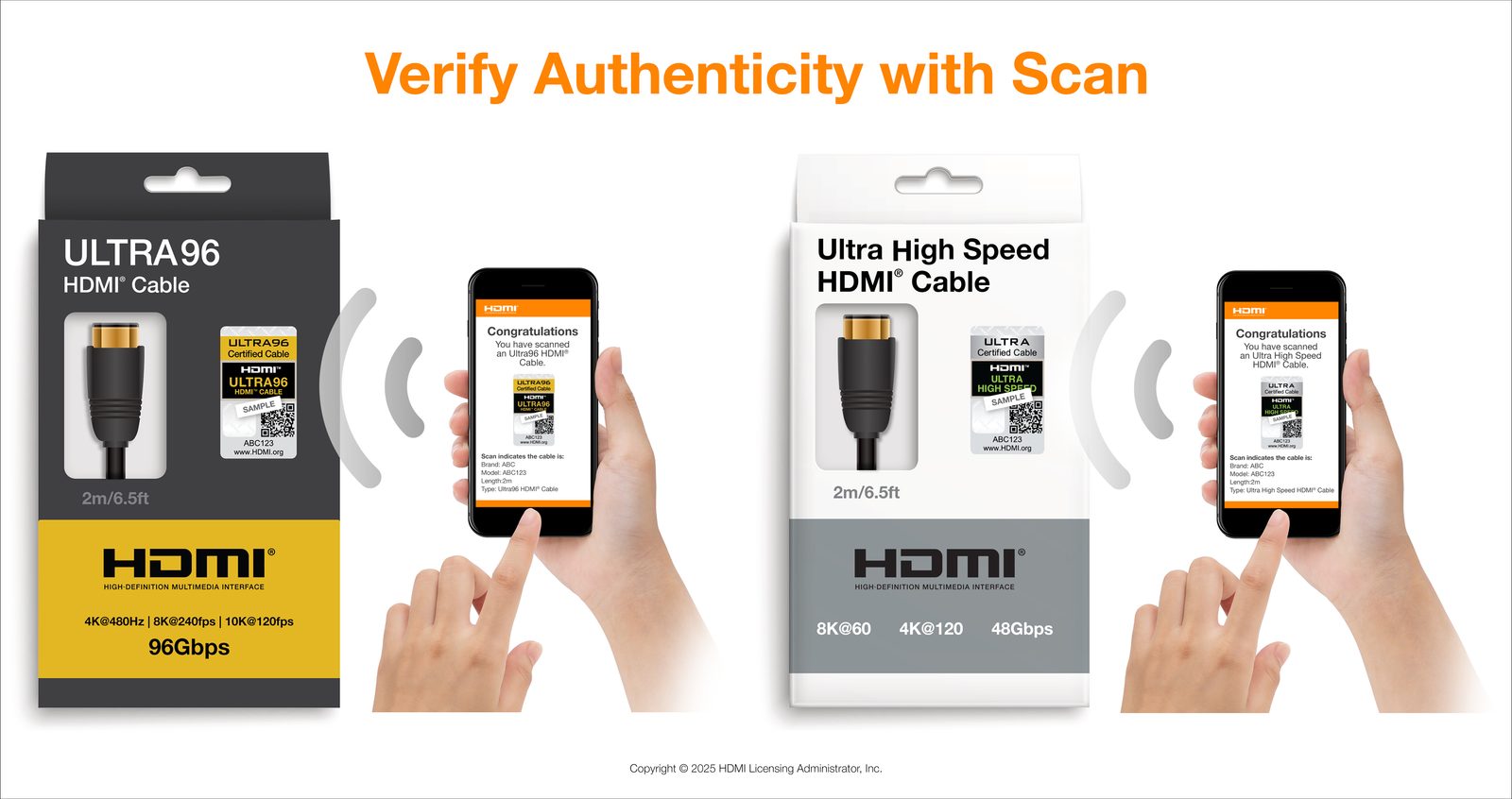
Source: hdmi.org — Ultra HDMI™ Cable Certification Program (PDF). The list of authorised test centres is published at hdmi.org — Authorized Test Centers.
Point 3 is the one that decides your sourcing plan
Every length is certified separately. Not every model — every length. A supplier who has certified 1m has certified 1m, and nothing else. If your bill of materials needs 1m, 2m and 3m, that is three separate certifications, and a supplier can be entirely truthful in saying “we are certified” while having nothing that fits your build.
At 96Gbps the reason is physical rather than bureaucratic: insertion loss and skew scale with length, and a construction that passes at short length does not automatically pass at longer length. Longer certified lengths are harder to achieve, which is exactly why they are worth asking about specifically.
So the question to put to any supplier is not “are you certified” but “which lengths are certified, and can I see the certificate number for the length I need”.
Where our samples stand
We are being deliberately precise here, because this is a subject where vague claims are common.
- We have submitted samples for Ultra96 HDMI™ Cable certification testing and testing is under way.
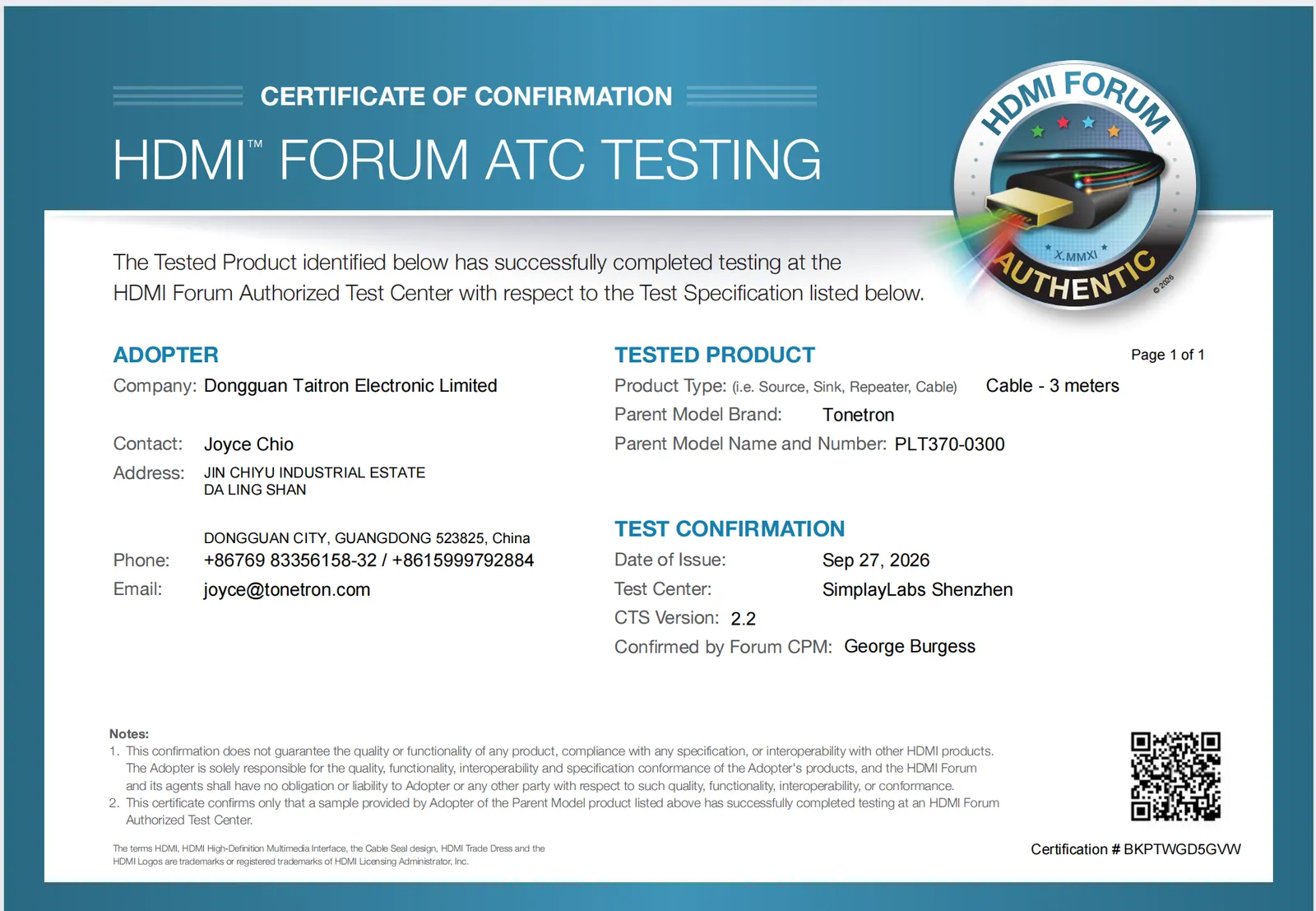
- We do not yet hold Ultra96 certification, and we will not describe any cable as certified until the certificate is issued. When it is, the certificate number will be published here so that you can verify it independently — the same way our existing HDMI Forum ATC confirmations (5QSIMQP4DLG, 2JCHSF3SL1X, MG3CQ3Z4BAG) can be checked today with the HDMI Forum.
- Our submitted constructions cover lengths up to 3 m. Given that every length is certified separately, this is the specific fact worth stating: 3 m is the longest construction we have put into testing.
One practical note, because it will confuse anyone who goes and checks: the public list of authorised test centres on hdmi.org still labels laboratories by their Ultra High Speed capability, and has not yet been updated to show Ultra96. That is a documentation lag, not a closed door. The test centre we work with has confirmed to us directly that it can carry out the testing — which is why our samples are already with them. If you look at the public list yourself and conclude that testing has not started, that conclusion would be wrong.
We expect results shortly. If you are planning a product that needs Ultra96 cable and you want to be in the first batch, tell us the length, connector type, jacket and volume you are working to, and we will tell you honestly whether it is inside what we have submitted or would need a further certification round.
Official material you can go and read
- HDMI™ 2.2 specification overview — bandwidth, resolutions and colour depth.
- Ultra96 feature name — the official definition and why the cable is required.
- Ultra HDMI™ cables — Ultra High Speed and Ultra96 cables compared.
- Ultra HDMI™ Cable Certification Program (PDF) — the six requirements, the test-and-label flow, and images of the genuine certification label.
- Authorized Test Centers — the current list of laboratories.
- HDMI™ press resources — official press releases, product images and comparison charts.
- Adopted Trademark and Logo Usage Guidelines — the rules on names, version numbers and logos.
Content reproduced above is attributed to HDMI Licensing Administrator, Inc.