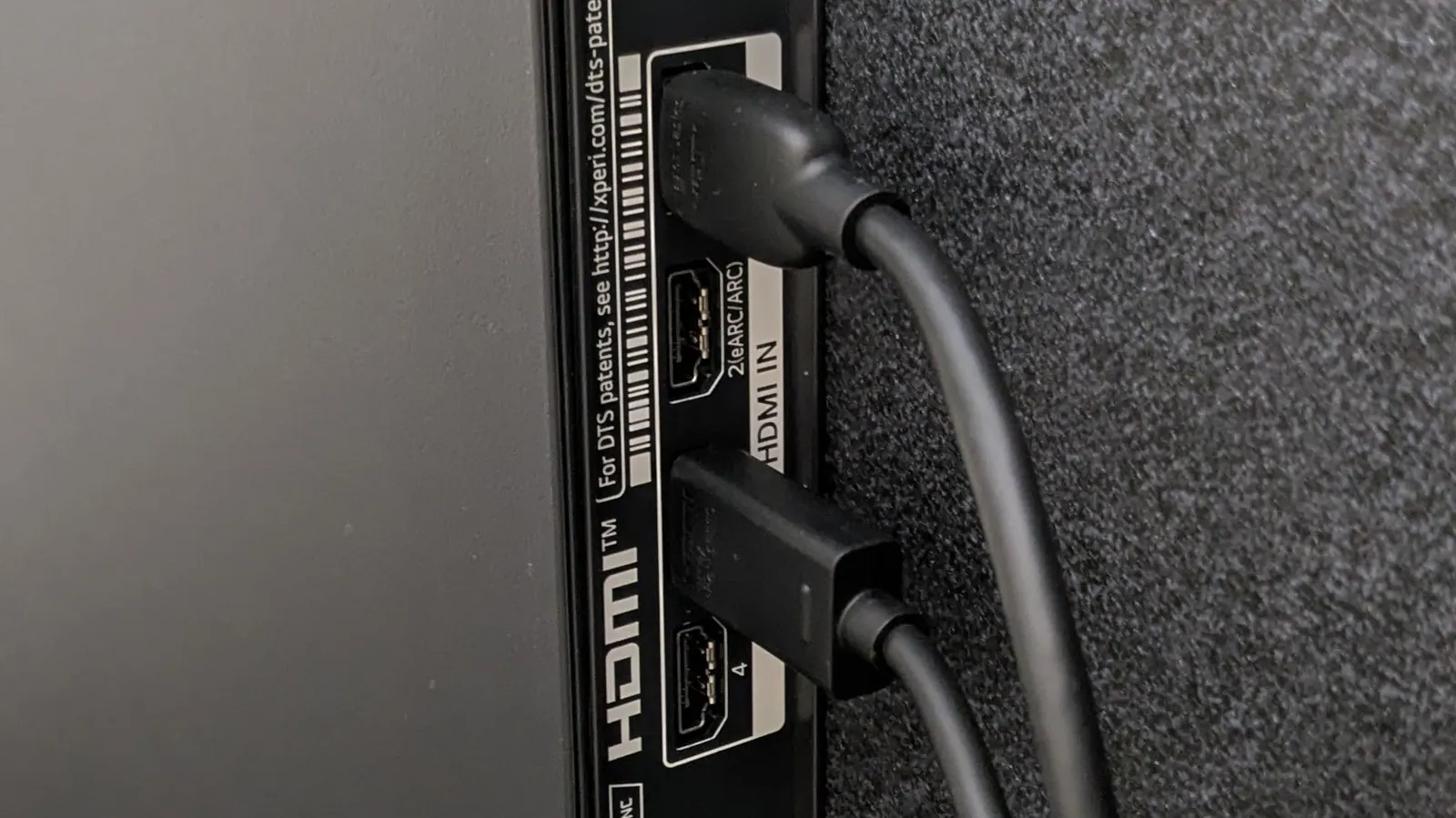
HDMI Licensing Administrator has said 96Gbps HDMI 2.2 products should begin appearing in 2027. The specification itself was announced at CES 2025 along with a new certified cable category, Ultra96. For anyone planning a cable range the interesting question is not the date — it is which parts of your current range will still be right afterwards.
What HDMI 2.2 adds
| HDMI 2.1 | HDMI 2.2 | |
|---|---|---|
| Maximum bandwidth | 48Gbps | 96Gbps |
| Certified cable category | Ultra High Speed | Ultra96 |
| Signalling | FRL | FRL, extended |
| Audio/video sync | eARC | eARC plus LIP (Latency Indication Protocol) |
| Announced | 2017 | CES 2025 |
The other addition nobody mentions: LIP
Bandwidth gets the headline, but HDMI 2.2 also introduces the Latency Indication Protocol, and for anyone selling into AV installation it may matter more day to day. LIP gives devices a defined way to report their own processing delay so that a chain — source, receiver, soundbar, display — can align audio and video correctly instead of relying on a manual lip-sync offset that someone dials in by ear and that drifts whenever the chain changes.
It changes nothing about cable construction. It is worth knowing because it is the part of HDMI 2.2 that improves setups running formats they already handle, rather than only the ones chasing 96Gbps.
Most of what ships today does not need 96Gbps
This is the part that gets lost in the headline. 96Gbps is aimed at formats that barely exist yet — 4K at 480Hz, 8K at 240Hz, 10K at 120Hz, and immersive and light-field applications. Meanwhile:
- 4K at 60Hz needs roughly 12Gbps and fits inside HDMI 2.0.
- 4K at 120Hz with 10-bit colour needs roughly 32Gbps and sits comfortably inside 48Gbps.
- 8K at 60Hz with 10-bit colour is close to 48Gbps — at the HDMI 2.1 limit, but inside it.
And Display Stream Compression lets HDMI 2.1 carry a good deal that exceeds 48Gbps uncompressed. So "this needs HDMI 2.2" is frequently really "this needs HDMI 2.2 or DSC". A range built on certified Ultra High Speed cable does not become obsolete in 2027; it stops being the top of the range.
What changes at the factory
Doubling the rate tightens every budget. Higher FRL rates mean less tolerance for insertion loss, inter-pair skew and impedance discontinuity, and that tolerance has to hold along the entire length rather than at the connector. A cable that passes at 48Gbps can fail at 96Gbps for reasons invisible from the outside — conductor consistency, dielectric uniformity, shielding coverage, termination repeatability.
This is why certification is done at an Authorized Testing Centre and why certified cables carry a scannable anti-counterfeit label rather than a printed claim.
What to do now
- Do not rebuild a range around 96Gbps yet. The displays that consume it are not shipping in volume.
- Do make sure the range you have is genuinely certified — by category name, with the label, and with a test report you can ask for.
- Ask your factory whether it has Ultra96 samples in test, which tells you whether it will be ready when your customers are.
- Keep describing cables by category, not version number. HDMI licensing rules discourage version numbers on cables precisely because they mislead — and that becomes more confusing, not less, once two bandwidth tiers exist.
Where our own cables sit
- HDMI A 8K/60 Certified Cable — PF331S — 48Gbps, ATC test confirmation at 1.5 m and 3 m
- HDMI A 16K 96Gbps Cable — PF442A — built for the 96Gbps tier
- All HDMI cables
Ask us for the specification sheet
Tonetron is the export brand of Dongguan Taitron Electronic Limited (东莞台昶电子有限公司), a cable and connector manufacturer in Dongguan, Guangdong, China, established in 1984. We build HDMI, DisplayPort, USB-C and custom cables on our own lines and ship factory-direct to more than 40 countries.
- Email: sales@tonetron.com
- Phone: +86-0769-83356158
- Contact form: tonetron.com/contact
Tell us the target specification, quantity and destination market and we will send the matching datasheet and a quote.