The USB Type-C specification is maintained by USB-IF and is the document that decides whether a cable is allowed to carry 5 A or 40 Gbps at all. It matters to buyers for one blunt reason: a USB-C connector guarantees nothing. Two cables that look identical, plug into the same ports and cost within a dollar of each other can differ by a factor of eighty in data rate and four in power. What separates them is what the specification requires to be inside.
The eMarker rule, stated plainly
An eMarker is a small read-only chip in the connector overmould. It announces the cable's identity and electrical rating over the CC (Configuration Channel) pin before any power or data negotiation happens. The specification requires one in two cases:
| Cable carries | eMarker required? |
|---|---|
| Up to 3 A (60 W) | No |
| Over 3 A — 5 A / up to 240 W | Yes |
| 5 Gbps or faster data | Yes |
| USB 2.0 data only, 3 A or less | No |
The consequence is the single most common support complaint in this category. Plug a 100 W charger into a cable with no eMarker, or one whose eMarker declares only 3 A, and the charger caps itself at 60 W — no error, no warning, just a laptop that charges slowly. The devices behaved correctly. The cable was the limit.
Power and data are declared separately
A point that costs buyers money: a cable rated for 240 W is not thereby fast, and a 40 Gbps cable is not thereby a 240 W cable. The eMarker carries both figures as independent fields, and a manufacturer can build either without the other. When you specify, name both:
- Current rating — 3 A or 5 A. 5 A at 48 V is what USB PD 3.1 Extended Power Range calls 240 W.
- Data rate — USB 2.0 (480 Mbps), 5/10/20 Gbps, or 40 Gbps and above for USB4.
- Video — whether DisplayPort Alt Mode is required, and at what rate.
A charging-only cable at 240 W is a legitimate and cheaper product. It is only a problem when it is sold as though it were also a data cable.
Why length is part of the specification, not an afterthought
The higher the data rate, the shorter passive copper can be before insertion loss and skew put the link outside its budget. As a working guide, a passive USB-C cable running 40 Gbps is limited to roughly 0.8 m; 20 Gbps and 10 Gbps allow progressively more. Past those points the honest answer is an active cable, not a longer passive one. A supplier who offers a 3 m passive cable at 40 Gbps is describing something the specification does not permit.
What to ask a supplier for
- The eMarker's declared values, not the marketing figure — current rating and data rate as the chip actually reports them.
- The cable's length at that rate, and whether it is passive or active.
- A test report, not only a certificate image. Ask which laboratory produced it and on which sample.
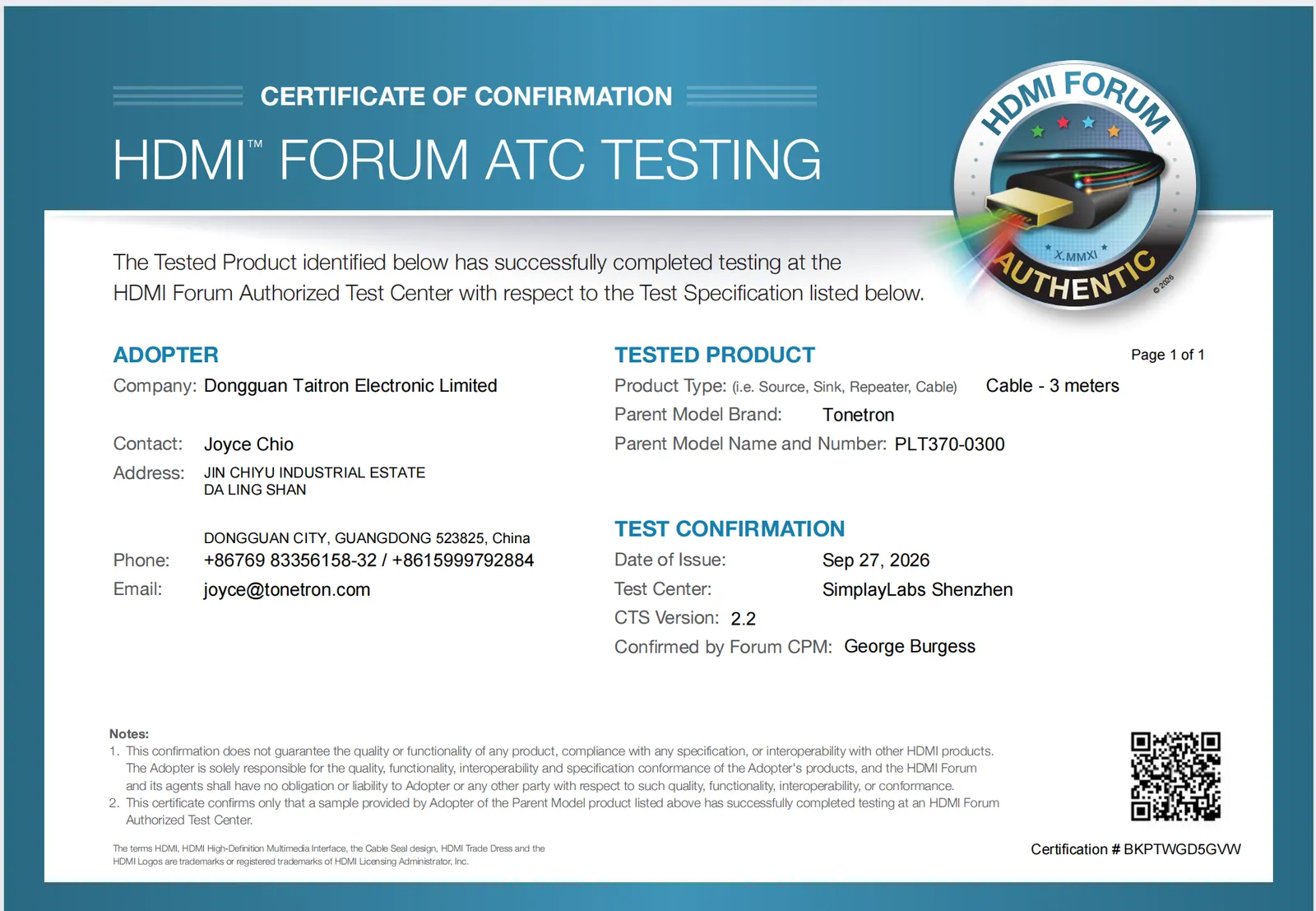
- A credential you can look up yourself. Ours is our HDMI™ Adopter registration — search Dongguan Taitron at hdmi.org. We also passed USB-IF USB4 certification testing under TID 6801; that USB-IF membership has since lapsed, so we publish the archived certificate on our credentials page rather than pointing you at a list you cannot open.
Where our own cables sit
- USB Type-C 40Gbps / 240W Cable, 2m — PLT588 — eMarked for 5 A and 40 Gbps
- All USB-C cables — 9 models across the power and data tiers
Ask us for the specification sheet
Tonetron is the export brand of Dongguan Taitron Electronic Limited (东莞台昶电子有限公司), a cable and connector manufacturer in Dongguan, Guangdong, China, established in 1984. We build HDMI™, DisplayPort, USB-C and custom cables on our own lines and ship factory-direct to more than 40 countries.
- Email: sales@tonetron.com
- Phone: +86-0769-83356158
- Contact form: tonetron.com/contact
Tell us the target specification, quantity and destination market and we will send the matching datasheet and a quote.