You’ve got three quotes on your desk. Same cable type, similar length, but the unit prices differ by 30%. Which one is the real deal, and which one will cost you in returns, rework, or lost sales?
The answer isn’t in the total price. It’s in the line items. A proper FOB quotation from a factory tells you exactly what you’re paying for—and what you’re not. Here’s how to read one, line by line, so you compare apples to apples.
The Anatomy of a Quotation
A professional cable manufacturer’s quotation template should include:
- Header: Quotation No., Date, Currency, Payment method (e.g., T/T 30 days), Trade term (e.g., FOB Shenzhen), validity period (typically 7 days)
- Line items: No., Product Description (internal part number like CPB485-0200-J01), Specification, Length, MOQ (pcs), Unit Price, Unit, Lead time, Remark
- Footer: Order taker / Sales / Approval — three signatures
| Column | Why it matters |
|---|---|
| No. | Identifies each line so questions and revisions refer to the same item. |
| Product Description | Names the cable and internal part number so suppliers quote the same product. |
| Specification | Records conductor gauge, shielding, connector plating and other requirements that drive cost. |
| Length | Makes copper usage and the quoted cable length comparable. |
| MOQ (pcs) | Shows the minimum purchase quantity and its effect on total order cost. |
| Unit Price | States the price per unit under the quotation’s currency and trade term. |
| Unit | Clarifies whether the price is per piece, set or another unit. |
| Lead time | Shows when the quoted quantity can be ready. |
| Remark | Records exceptions, packaging details and costs that need clarification. |
If any of these are missing, you can’t compare quotes. Full stop.
What Drives the Unit Price? Six Cost Blocks
Every cable’s unit price is built from six components. Understanding them lets you spot whether a low quote is a bargain or a trap.
1. Conductor (Copper)
The raw copper price fluctuates daily. But the real cost difference comes from wire gauge (AWG) and length. A 2m USB-C cable with 24AWG power conductors uses significantly more copper than one with 28AWG. That’s a structural difference, not a pricing trick. Always check: what AWG is specified? Is it the same across all quotes?
2. Shielding
Shielding type—aluminum foil, braid, or dual-layer—directly affects signal integrity at higher speeds. A USB4 or HDMI™ 2.1 cable needs robust shielding to pass certification. If one quote doesn’t specify the shielding structure, you can’t compare it to another that does.
3. Connector & Plating
24K gold plating on the connector pins costs more than nickel plating. It also ensures better corrosion resistance and signal contact over thousands of insertions. If the plating isn’t stated, assume the cheapest option.
4. Tooling & NRE
Molds and development fees can be charged as a one-time cost or amortized into the unit price. If amortized, ask: over how many units? A low unit price might mean the NRE is hidden elsewhere—or not included at all.
5. Packaging
Bulk packing (loose in a bag) is cheapest. OPP bags, color boxes, or blister cards add cost. Private-label printing has a minimum order quantity (MOQ) that affects the unit price. If your quote doesn’t specify packaging, you’re comparing different products.
6. Testing & Certification
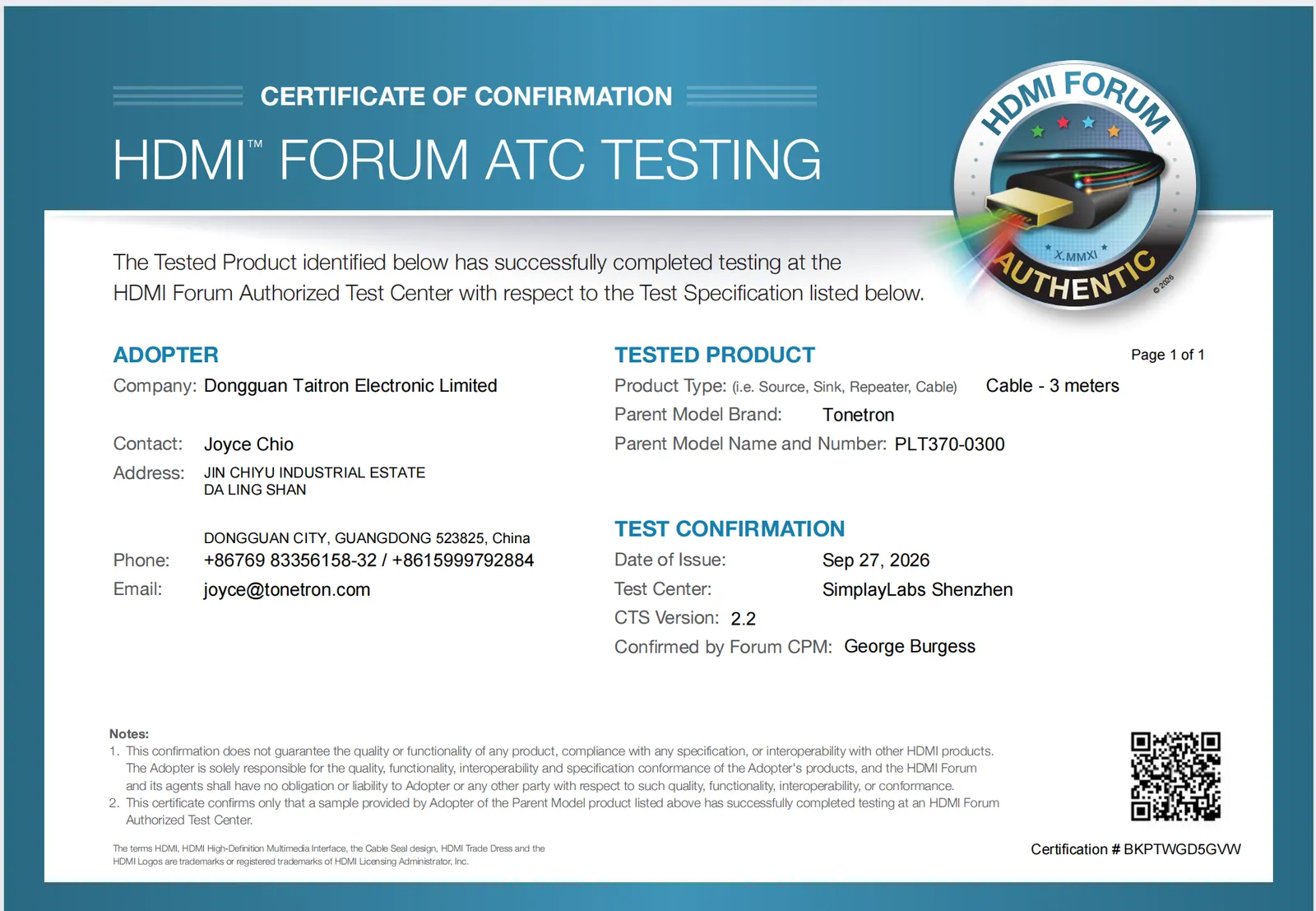
HDMI Forum ATC testing and USB-IF certification are per-model costs. A cable that has passed these tests carries that test cost in its unit price.
Comparison Table: How to Align Two Quotes
| Line Item | What Drives It | How to Make Two Quotes Comparable | Red Flag |
|---|---|---|---|
| Conductor | Copper price, AWG, length | Confirm same AWG and length across all quotes | AWG not stated |
| Shielding | Foil/braid/dual-layer, speed class | Ask for shielding structure in writing | Shielding not specified |
| Connector & Plating | Gold vs. nickel, contact design | Specify plating thickness (e.g., 30µ” gold) | Plating not mentioned |
| Tooling & NRE | Mold cost, development hours | Ask: one-time or amortized? Over how many units? | NRE not listed at all |
| Packaging | Bulk/OPP/color box/private label | Define packaging spec and MOQ | Packaging not described |
| Testing & Certification | HDMI ATC, USB-IF, per-model fees | Request certification certificates per SKU | “Certified” claimed but no cert number |
Three Rules Before You Compare
- If the quote doesn’t state the wire gauge, you can’t compare copper cost.
- If the quote doesn’t specify shielding, you can’t compare signal integrity.
- If the quote has no MOQ or validity period, it’s not a real quote.
FAQ
How do I verify a factory’s HDMI™ certification without asking them?
Go to the official HDMI™ Adopter directory at https://www.hdmi.org/adopter/adoptersaffiliates and search “Dongguan Taitron.” The entry shows Dongguan Taitron Electronic Limited, Adopter since June 2005, HDMI™ 2.2 Adopter, with the current certificate valid to 2027-06-22. This is public, real-time, and requires no document from the supplier.
What should I do if two quotes have the same unit price but different MOQs?
Calculate the total cost at your actual order quantity. A lower MOQ with a slightly higher unit price may be cheaper overall than a low unit price that forces you to buy 10x your need. Also check if the NRE is amortized—a low MOQ might mean the NRE is charged separately.
Why would a factory quote a 30% lower price on the same cable?
Possible reasons: different AWG (thinner copper), no shielding, nickel instead of gold plating, bulk packaging, no certification testing, or NRE not included. Ask for the specification sheet line by line. If they can’t provide it, the quote is not comparable.
Related reading: What determines MOQ for custom cables · B2B Cable Sourcing FAQ.
Request an OEM/ODM quote
Tonetron is the export brand of Dongguan Taitron Electronic Limited (东莞台昶电子有限公司), a cable and connectivity manufacturer in Dongguan, Guangdong, China. We supply HDMI™, USB-C, DisplayPort and custom cables worldwide, with OEM/ODM and private-label programs.
- Email: sales@tonetron.com
- Phone: +86-0769-83356158
- Contact form: tonetron.com/contact
Tell us your target specification, quantity and destination market and our team will respond with a tailored quote. MOQ, sample, tooling and lead-time figures are project-specific — please contact us for a quote.