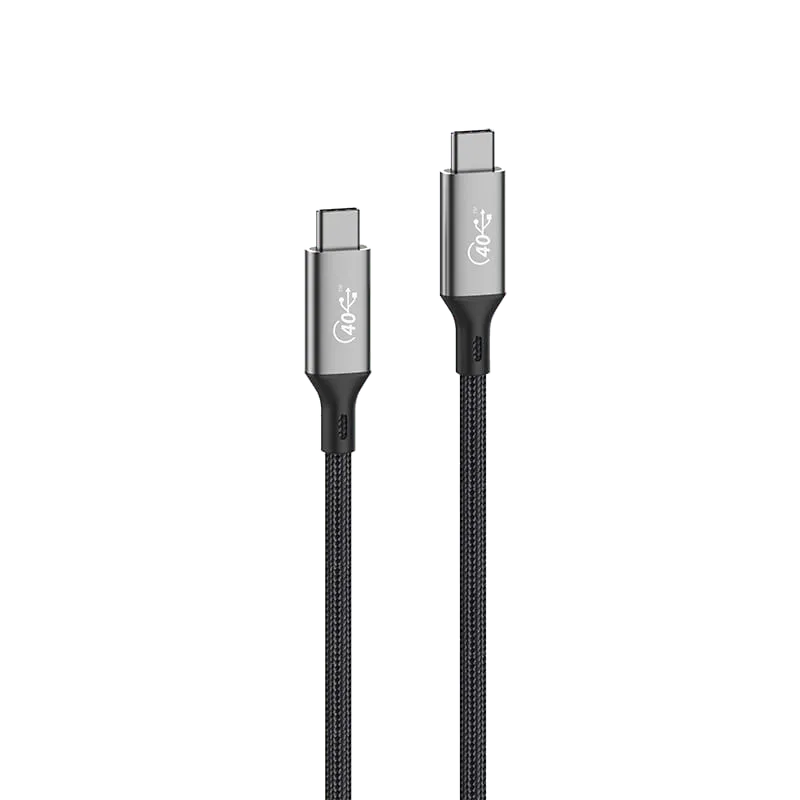
240W is the ceiling of USB Power Delivery 3.1 Extended Power Range (EPR). It is reached at 48V × 5A. Everything about a 240W cable follows from those two numbers, and most of what goes wrong in sourcing comes from suppliers treating "240W" as a label rather than a set of requirements.
The EPR voltage ladder
USB PD 3.0 topped out at 20V, giving 100W at 5A. PD 3.1 added three fixed voltages above that.
| Power | Voltage | Current | Range |
|---|---|---|---|
| 60W | 20V | 3A | Standard (SPR) |
| 100W | 20V | 5A | Standard (SPR) |
| 140W | 28V | 5A | Extended (EPR) |
| 180W | 36V | 5A | Extended (EPR) |
| 240W | 48V | 5A | Extended (EPR) |
Note that current stops at 5A across the whole EPR range. The extra power comes entirely from raising voltage. That has an important consequence: a 240W cable and a 100W cable carry the same current. What separates them is insulation rating and E-Marker declaration, not conductor size alone.
The E-Marker is mandatory and specific
An EPR cable must contain an E-Marker that declares support for 50V and 5A. This is not optional and it is not a formality — the power source reads it before it will offer any voltage above 20V. A cable whose E-Marker declares 20V/5A will charge at 100W and no more, whatever the packaging says.
This is the single most useful question to ask a supplier: what does the E-Marker declare? If the answer is not "50V, 5A", the cable is not a 240W cable.
Conductor gauge and voltage drop
At 5A, conductor resistance turns directly into heat and voltage drop. Thinner wire is cheaper and is the most common place cost gets cut invisibly.
- Power pair gauge — ask for the AWG of VBUS and GND specifically, not "the cable". A cable can have thick-sounding overall construction and thin power conductors.
- Length — drop scales with length. A 2 m cable needs heavier conductors than a 1 m cable for the same performance.
- Temperature rise — ask for the measured rise at 5A continuous. This is a number a real factory can measure and a trading company usually cannot.
Data rate is a separate question
Power and data are negotiated independently. A 240W cable may be USB 2.0 only (480Mbps) — that is a perfectly legitimate product and it is what most charging cables are. If you need both 240W and high-speed data, you must specify both; do not assume one implies the other.
Our USB Type-C 4 40Gbps / 240W Cable — PLT588 is an example of a cable specified for both: 40Gbps USB4 data and 240W EPR power over 2 m.
A four-question check before you order
- What does the E-Marker declare? Must be 50V / 5A.
- What is the AWG of the power conductors, at the length you are buying?
- What is the measured temperature rise at 5A continuous?
- Is it USB-IF certified, and if so what is the TID? Certification is checkable at usb.org.
A supplier who can answer all four from their own test data is manufacturing. One who cannot is reselling.
Ask us for the specification sheet
Tonetron is the export brand of Dongguan Taitron Electronic Limited (东莞台昶电子有限公司), a cable and connector manufacturer in Dongguan, Guangdong, China, established in 1984. We build HDMI, USB-C, DisplayPort and custom cables on our own lines and ship factory-direct to more than 40 countries.
- Email: sales@tonetron.com
- Phone: +86-0769-83356158
- Contact form: tonetron.com/contact
Tell us the target specification, quantity and destination market and we will send the matching datasheet and a quote. MOQ, tooling and lead-time figures are project-specific.