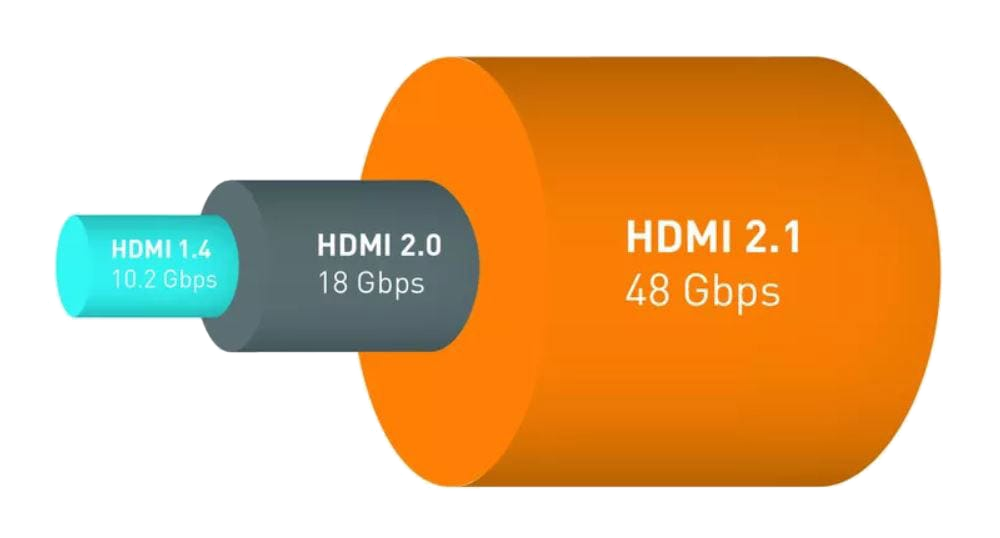
Originally released in November 2017, HDMI 2.1 is arguably the most significant upgrade to the HDMI standard. Its bandwidth increases to 48 Gbps, which is 2.67 times the bandwidth of HDMI 2.0 (18 Gbps).
HDMI 2.0 and its newer cousin, HDMI 2.0b, have remained the most common versions of the HDMI standard for the past five years. Since 2019, the TV industry has been the first to pave the way for HDMI 2.1, which has become the standard on 8K Ultra HD TVs. The best 4K TVs also feature HDMI 2.1 in large numbers, and the next generation of gaming consoles, the PS5 and the Xbox Series X, due out in late 2020, also come with HDMI 2.1.
Because HDMI 2.1 is still a relatively new standard, you don't have to worry too much about the obsolescence of your 4K TV, streaming media player, or 4K Ultra HD Blu-ray player. But if you're planning on buying a high-end TV, make sure it comes with an HDMI 2.1 port, especially for movies and games.
HDMI 2.1 Specification Overview
- Connector physical specifications are the same as today's HDMI, with downward compatibility.
- Needs better shielding performance and cables with better EMI resistance.
- Bandwidth increased to 48 Gbps, 2.67 times higher than HDMI 2.0 (18 Gbps).
- Can carry video signals up to 10K@120fps.
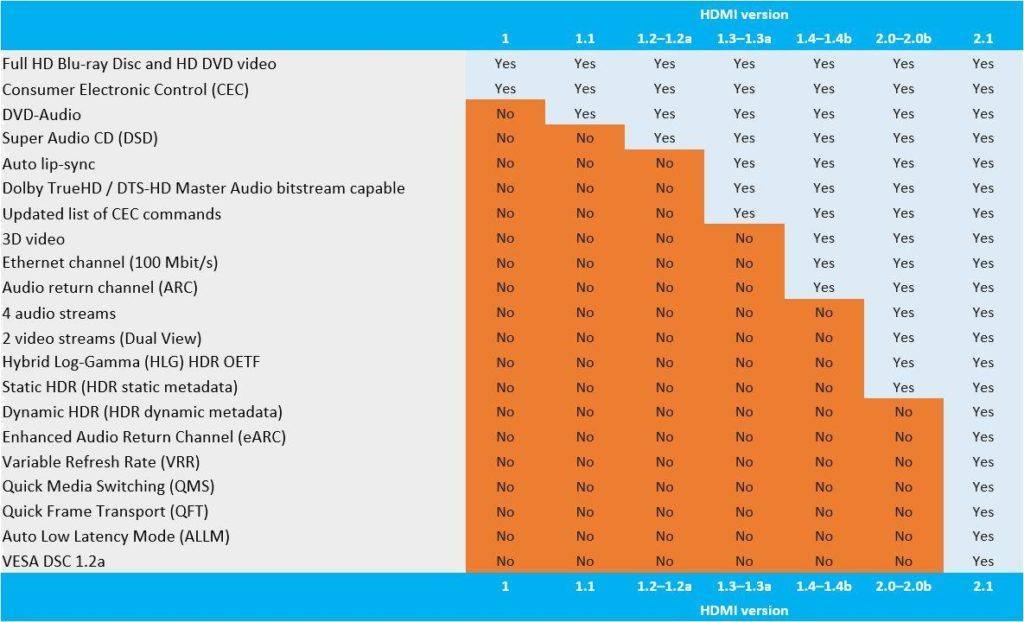
- New audiovisual features: dynamic HDR and enhanced audio return channel (eARC).
- New gaming features: Variable Refresh Rate (VRR), Quick Frame Transport (QFT), Auto Low Latency Mode (ALLM), and Quick Media Switching.
- New video compression format: VESA DSC 1.2a.
More Bandwidth
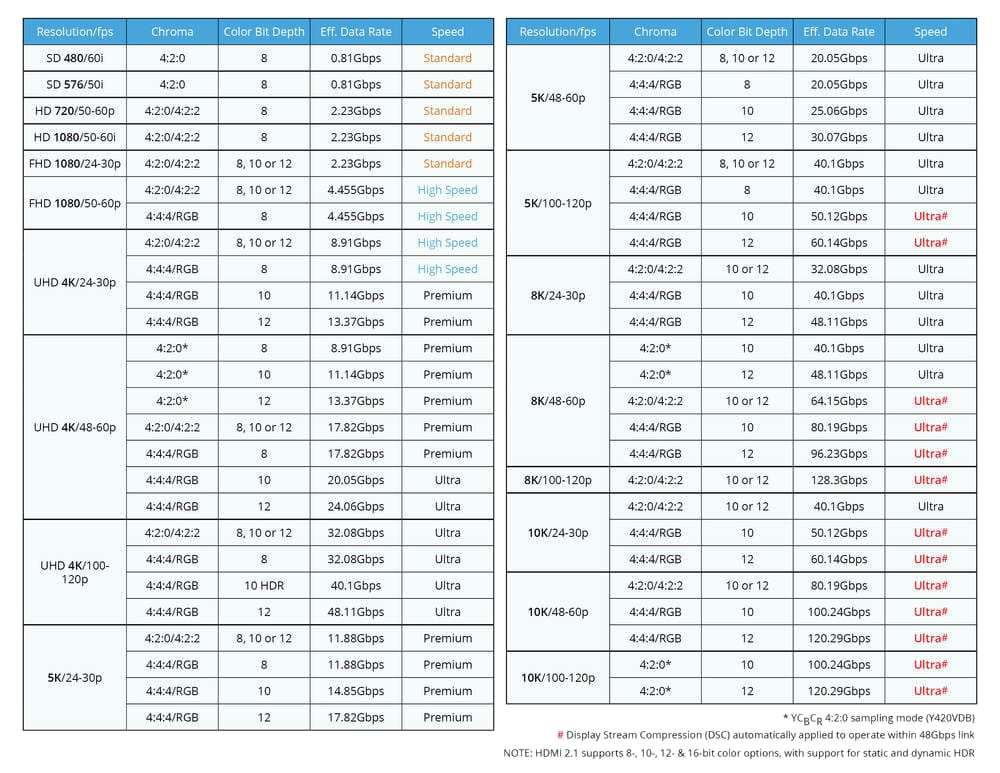
As you increase the resolution of a video signal, the amount of data in that signal increases. The data volume of a 3,840x2,160 4K Ultra HD signal sent via HDMI is about four times that of an HD 1,920x1,080 signal. If you think of cables as pipes, you'll need pipes larger than those for 1080p to carry 4K signals. The same is true if you increase the frame rate: you need a larger pipe to transmit images at 60 frames per second instead of 24fps at the same resolution. More images per second means more data.
HDMI 2.1, 2.0 and 1.4 Bandwidth Comparison
The HDMI 2.1 standard increases the maximum uncompressed bandwidth that HDMI cables can handle to 48 Gbps and the maximum compressed bandwidth to at least 128 Gbps. While it will be some time before devices actually need that much bandwidth, the 18 Gbps of HDMI 2.0 has become a bottleneck in many cases. For example, transmitting a 4K@60Hz video signal with 4:4:4 chroma sub-sampling and 10-bit depth requires 20.05 Gbps of bandwidth, which is more than an HDMI 2.0 connection alone can provide.
Higher Resolution and Refresh Rate
The increased bandwidth of HDMI 2.1 supports video signal transmission up to 10K (10240x4320), covering most of the new resolutions, chroma sampling, bit depths and refresh rates that an HDMI 2.1 single-pair connection allows. For video signals above 4K@60Hz, the required bandwidth is greater than HDMI 2.0's 18 Gbps, so 8K TVs and high-end 4K TVs should be equipped with an HDMI 2.1 interface; otherwise it is necessary to connect multiple HDMI 2.0 cables (if the TV supports it).
What Are the New Features of HDMI 2.1?
In addition to the huge improvement in resolution and refresh rate, HDMI 2.1 has other useful new features.
Dynamic HDR
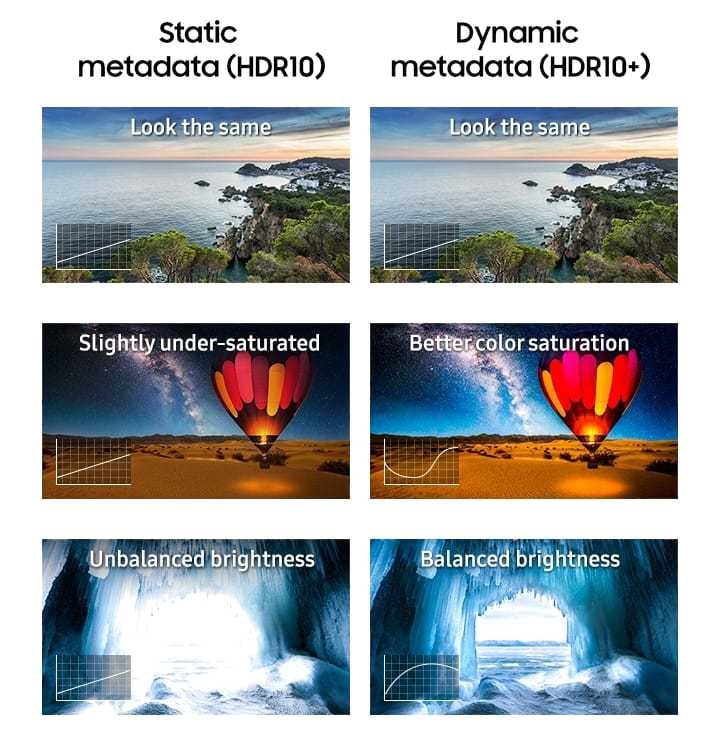
HDR (High Dynamic Range) is one of the most welcome picture-quality improvements since the 4K era, promising higher contrast and richer colors for video content. The most common HDR format today is HDR10, which uses metadata recording the actual brightness level of the video content to tell the TV how to restore color and contrast. In HDR10 there is only one set of this metadata per video, but the actual brightness varies from scene to scene, so contrast restoration for each scene is inevitably biased. With dynamic HDR, the metadata (true brightness levels) of each scene and each frame can be different to better fit a particular scene or frame, so the TV's restoration varies according to the metadata. Advanced HDR formats such as Dolby Vision, HDR10+ and Advanced HDR already use dynamic metadata and can be delivered over existing HDMI connections but require additional bandwidth; HDMI 2.1 adds a new channel for dynamic metadata transmission, which completely solves this problem.
Enhanced Audio Return Channel (eARC)
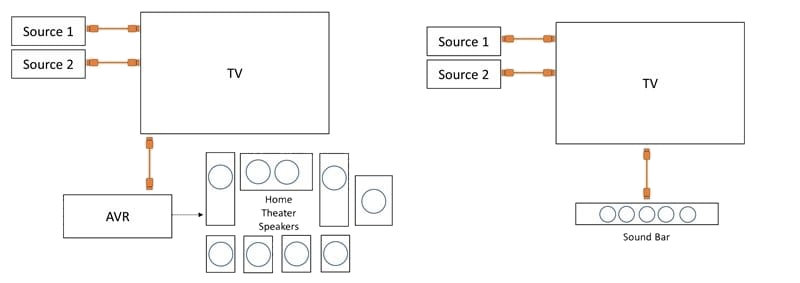
Since version 1.4, the Audio Return Channel (ARC) has been part of the HDMI standard. ARC lets you connect all source devices (Blu-ray players, game consoles, etc.) directly to your TV and then use an HDMI cable to transmit sound to a soundbar, receiver, or other sound system. It greatly simplifies cabling and lets you use the TV remote to control the audio equipment. However, ARC's limited bandwidth (~1 Mbps) caps the audio quality and makes it impossible to send high-quality uncompressed audio. eARC dramatically increases the available bandwidth to 37 Mbps, enough to send lossless 5.1 and 7.1 audio such as Dolby TrueHD and DTS-HD MA, the carrier signals for Dolby Atmos and DTS:X.
VESA DSC 1.2a Display Stream Compression
With the popularity of modern high-bit-rate video, video signals require ever more bandwidth, so a new compression method is needed. The most common method is Display Stream Compression (DSC). Originally developed on computer platforms, DSC could not efficiently encode most television signals because it was only compatible with RGB-encoded video. The VESA group responsible for DSC released an updated version, DSC 1.2a, which supports a maximum color depth of 16 bits and enables native YCbCr 4:2:0 and YCbCr 4:2:2 encoding without first converting to RGB. HDMI 2.1 supports this technology (though not all HDMI 2.1 devices do), which multiplies the maximum bandwidth HDMI 2.1 cables can transmit to 120 Gbps without compromising image quality. Only very high resolution, high refresh rate devices require DSC.
Variable Refresh Rate (VRR)
Variable Refresh Rate is the feature gamers are most interested in. It synchronizes the refresh rate of the screen and the signal source (the graphics card output) for a smoother game experience, reducing or eliminating lag, stutter and frame tearing. With fewer buffered frames, you no longer have to choose between image artifacts and input lag—ideally reducing both. It is similar to Nvidia's G-Sync and AMD's FreeSync, which are only available through DisplayPort; VRR is the VESA version.
Quick Frame Transport (QFT)
Quick Frame Transport changes the way images are transferred from the signal source to the display, transmitting each frame at a higher rate to reduce latency. Total input delay results from many factors, including the time the monitor takes to process and display the image. QFT does not eliminate input delay completely, but it reduces the delay caused by transmission time between source and display. Input lag is one of the most important indicators of how good a TV is for gaming, making this a game-friendly feature.
Auto Low Latency Mode (ALLM)
Auto Low Latency Mode, also known as automatic gaming mode, is another feature designed for gamers. A compatible TV automatically turns on its low-latency (gaming) mode when it detects that a game is being played, saving you the trouble of turning it on manually every time. It can even distinguish between playing a game and watching a movie and switch automatically as needed. Samsung led the industry in this feature, with some 2018 models already compatible.
Quick Media Switching (QMS)
In the past, display devices such as televisions and monitors turned the screen black for a few seconds before displaying new video whenever any parameter of the source changed. This is especially common with console games, where output refresh rate and even resolution can vary depending on the content. Quick Media Switching solves this: if the source and display are compatible, the black screen no longer appears when the source switches video formats—it switches to the new source immediately.